HRIS: The Starting Point for Your HR Digital Transformation
In a world where digital transformation is becoming essential to staying competitive, companies must adopt innovative and iterative approaches to succeed, avoid complexity, and drive rapid, high-impact results.
In writing this article, we drew on our extensive discussions with our clients and partners regarding the implementation of talenteo.com, our HR and payroll software.
Here, we draw a parallel between the iterative approach that innovative companies take to develop their products and the approach taken by a company seeking to digitally transform its HR processes.
The Benefits of an Iterative/Agile Approach
The iterative (Agile) approach involves breaking a project down into small steps. Each step aims to deliver a functional version of the product that can be evaluated and improved based on feedback. This allows for:
- Minimizing risks: By working in small steps, errors can be quickly identified and corrected.
- Increasing flexibility: Priorities can be adjusted based on feedback and market developments.
- Optimizing resources: Efforts are focused on specific tasks, reducing waste and increasing efficiency.
- Accelerate adoption: Core features can be deployed quickly, allowing the software to be tested in real-world conditions and enabling continuous improvements.
Avoid starting with a project that is too complex
Having ambition is great, but trying to implement complex HR software right away is often counterproductive. Here’s why it’s crucial to avoid this approach:
- Increased complexity: Highly complex systems require a deep understanding, extensive training, and sometimes unnecessary features.
- High costs: Developing and deploying complex solutions involves significant upfront costs, both in terms of time and financial resources.
- Extended deployment time: thereby delaying the expected benefits of digital transformation.
- User frustration: End users may feel overwhelmed by the system’s complexity, which can lead to resistance to change and slower adoption.
HRIS: The First Step Toward HR Digitalization
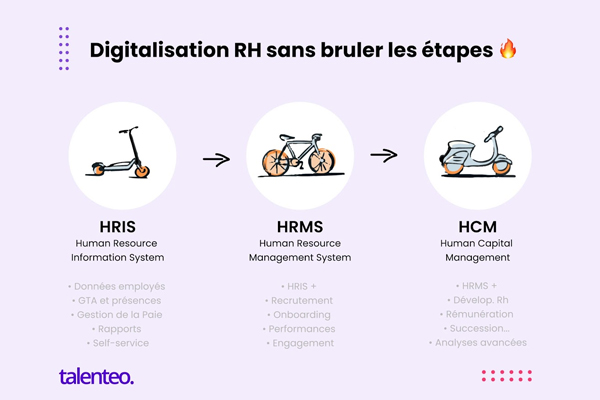
An HR Information System (HRIS) is the foundation—the essential building block—for any company seeking digital transformation. It is the ideal starting point before adopting more complex systems such as an HRMS or an HCM.
Features of an HRIS
💻 Employee Data Management
💻 Benefits Administration
💻 Payroll Processing
💻 Time and Attendance Management
💻 Reporting and Analytics
💻 Employee Self-Service
The Benefits of an HRIS
👀 Better record keeping
👀 Compliance
👀 Efficiency
👀 HR strategy
👀 HR self-service
👀 Enhanced employee experience
HRMS and HCM: The Next Steps
Once the groundwork has been laid with an HRIS, companies can move on to more complex systems such as Human Resources Management Systems (HRMS) and Human Capital Management (HCM).
Features of an HRMS
💼 HRIS Features +
💼 Recruitment and Application Tracking
💼 Onboarding
💼 Performance Management
💼 Employee Engagement
The Benefits of an HRMS
🔍 Improved recruitment processes
🔍 Smoother onboarding of new employees
🔍 Better performance and goal management
🔍 Increased employee engagement
Features of an HCM
🏢 HRMS Features +
🏢 Learning and Development
🏢 Compensation Management
🏢 Succession Planning
🏢 Industry Data and Benchmarks
🏢 Advanced Analytics and Business Intelligence
The Benefits of an HCM
📈 Continuous employee skill development
📈 Optimizing compensation management
📈 Strategic succession planning for key positions
📈 Using data to make informed decisions
📈 Improving overall organizational performance
Now is the time to take the plunge! Investing in an HRIS today lays the groundwork for your digital success in human resources management. An HRIS not only helps you streamline and optimize core HR processes, but also creates a solid foundation for integrating more advanced systems in the future. 🚀
Our advice is to take an iterative approach: start with simple, essential features before moving on to more complex ones, digitize your HR processes, and observe how this impacts your company’s performance.
Would you like to discuss this with female professionals? VisitTalenteo.com