- sarah.salhi
- 03/08/2026
- 4:39 pm
Comment choisir un logiciel RH & paie en 2026
Choisir un logiciel RH & Paie en Algérie représente un enjeu stratégique pour votre entreprise. Au-delà de la conformité réglementaire, ce choix influence directement la qualité de vos relations de travail, la fiabilité de vos processus RH et la confiance que vos collaborateurs accordent à votre organisation. La réglementation algérienne impose des obligations précises en matière de déclarations sociales, de calcul de l’IRG et de cotisations CNAS. logiciel RH & Paie adapté au contexte local vous permet de sécuriser ces processus tout en libérant du temps pour les missions à forte valeur ajoutée. Ce guide détaille les critères essentiels pour évaluer et sélectionner la solution qui correspond aux besoins de votre entreprise.Points clés : Comment choisir un logiciel RH et paie en Algérie en 2026
- Algerian regulatory compliance (Law No. 90-11, CNAS, IRG) must be natively integrated into the HRIS to avoid penalties and surcharges.
- Talenteo centralizes your HR data and automates payroll calculations in accordance with local requirements, reducing errors and processing time.
- A modular HRIS allows you to enable only the features you need and scale as your business grows.
- Local assistance and responsive customer support are key factors in ensuring a successful deployment and adoption by your teams.
- Centralizing employee records, time tracking, and payroll on a single platform reduces the need for duplicate data entry and keeps your data secure.
Qu’est-ce qu’un logiciel RH et paie et pourquoi est-il essentiel en Algérie ?
Un Système d’Information des Ressources Humaines (SIRH) avec paie intégrée regroupe sur une plateforme unique la gestion administrative du personnel, le suivi du temps de travail, les congés et absences, ainsi que le calcul automatisé des salaires. Cette centralisation élimine les ressaisies manuelles entre différents outils et réduit considérablement les risques d’erreur. En Algérie, le cadre légal encadrant les relations de travail et la paie est particulièrement structuré. La Loi n° 90-11 relative aux relations de travail, les lois de finances annuelles et les décrets d’application définissent des obligations strictes. Les délais de déclaration CNAS, le calcul du barème IRG progressif et les cotisations sociales exigent une rigueur qui devient difficile à maintenir avec des outils non spécialisés. Au-delà de la conformité, un SIRH avec paie adapté au marché algérien vous aide à construire une relation de confiance avec vos collaborateurs. Chaque fiche de paie exacte, chaque déclaration transmise dans les délais renforce la crédibilité de votre gestion RH.What are the regulatory requirements that must be met regarding payroll in Algeria?
Tout employeur en Algérie doit respecter un ensemble d’obligations légales dont le non-respect expose à des sanctions financières. Les déclarations auprès de la CNAS constituent une exigence centrale : affiliation des salariés dans les 10 jours suivant le recrutement, déclaration et versement des cotisations dans les 30 jours suivant chaque échéance. Le taux de cotisation de 34,5% se répartit entre la part employeur (25%), la part salarié (9%) et les œuvres sociales (0,5%). Les retards entraînent des majorations progressives : 10% si le retard n’excède pas un mois, 20% entre un et deux mois, et 25% au-delà de deux mois selon le journal officiel. Les amendes peuvent atteindre 5 000 DZD pour absence ou retard de déclaration. Le calcul de l’Impôt sur le Revenu Global (IRG) sur salaires suit un barème progressif que les lois de finances ajustent régulièrement. Un SIRH doit intégrer ces mises à jour automatiquement pour garantir la conformité de vos bulletins de paie. La gestion automatisée de la paie permet de sécuriser ces calculs.What functional criteria should you evaluate when choosing your HRIS?
L’évaluation d’un SIRH passe par l’analyse de ses fonctionnalités au regard de vos processus métier. Un module d’administration RH centralisé doit permettre de gérer les dossiers employés, les contrats, les documents administratifs et l’historique de chaque collaborateur sur une interface unique. La gestion du temps et des absences représente un second pilier. Suivez les présences en temps réel, gérez les demandes de congés avec des workflows d’approbation configurables et synchronisez ces données directement avec le calcul de paie. Cette intégration évite les écarts entre les heures travaillées et les heures rémunérées.How do you evaluate payroll features?
Le module de paie doit couvrir l’ensemble des besoins spécifiques au contexte algérien. Les éléments de paie configurables (primes, indemnités, avantages en nature) doivent s’adapter à votre convention collective. Le calcul automatique des cotisations CNAS et de l’IRG selon les barèmes en vigueur garantit la conformité de chaque bulletin. La génération des documents légaux (attestations de travail, déclarations sociales et fiscales) doit se faire en quelques clics. Vérifiez que le SIRH propose également la gestion des prêts et avances avec suivi des remboursements, une fonctionnalité appréciée par les collaborateurs.How much importance should be placed on the employee portal?
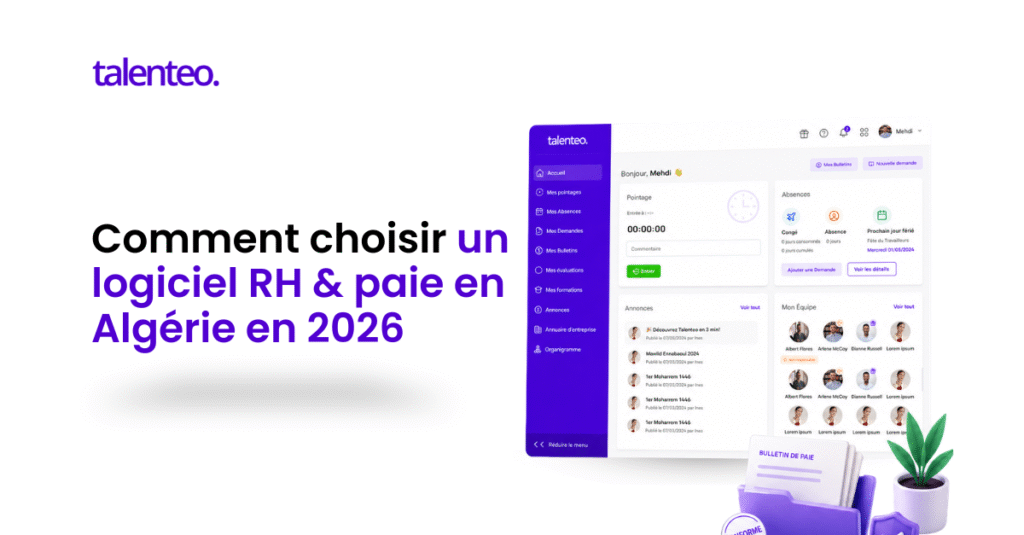
Un portail en libre-service permet à chaque collaborateur de consulter ses fiches de paie, son solde de congés et ses informations personnelles. Cette autonomie réduit la charge de travail de votre service RH et améliore l’expérience collaborateur. Le portail employé Talenteo illustre cette approche centrée sur l’utilisateur. La possibilité pour les salariés de soumettre leurs demandes (congés, documents, modifications) directement via la plateforme fluidifie les échanges et crée une traçabilité complète de chaque interaction.How can you ensure local compliance and stay up to date with regulatory changes?
La réglementation RH et paie en Algérie évolue chaque année avec les lois de finances, les révisions du SNMG et les ajustements des barèmes. Un SIRH doit intégrer ces changements automatiquement, sans intervention manuelle de votre part. Interrogez l’éditeur sur sa veille réglementaire : comment suit-il les évolutions légales algériennes ? Sous quel délai les mises à jour sont-elles déployées ? Une solution développée localement présente généralement un avantage sur ce point, car l’équipe connaît les spécificités du terrain. Talenteo, en tant que solution algérienne, maintient son moteur de calcul à jour avec la législation en vigueur. Les déclarations sociales et fiscales générées respectent les formats exigés par les organismes. Cette conformité native vous libère de la veille réglementaire quotidienne.What questions should you ask about data integration and centralization?
La dispersion des données RH entre plusieurs outils (fichiers Excel, logiciels non connectés, documents papier) génère des risques d’incohérence et des pertes de temps considérables. Un SIRH centralisé doit devenir le référentiel unique de toutes vos informations collaborateurs. Évaluez les capacités d’intégration avec vos outils existants. La synchronisation avec les pointeuses physiques permet de récupérer automatiquement les données de présence. La connectivité avec les pointeuses biométriques évite les ressaisies manuelles et les erreurs de transcription. La question de l’import des données historiques mérite attention lors du déploiement. Comment migrer les dossiers employés existants ? Les contrats en cours ? L’historique de paie ? Un accompagnement structuré sur cette phase conditionne la réussite du projet.Why is the modularity of an HRIS a key factor?
Not all companies have the same functional needs at the same time. An SME with 50 employees does not necessarily use the same modules as a corporation with 1,000 employees spread across multiple locations.Un SIRH modulaire vous permet d’activer uniquement les fonctionnalités correspondant à vos priorités actuelles : administration RH, gestion du temps, paie, développement des talents. Vous pouvez ensuite enrichir votree périmètre fonctionnel au rythme de la croissance de votre entreprise.
This approach avoids excessive upfront investment and ensures a gradual adoption by your teams. Each module added benefits from the data centralization that is already in place.