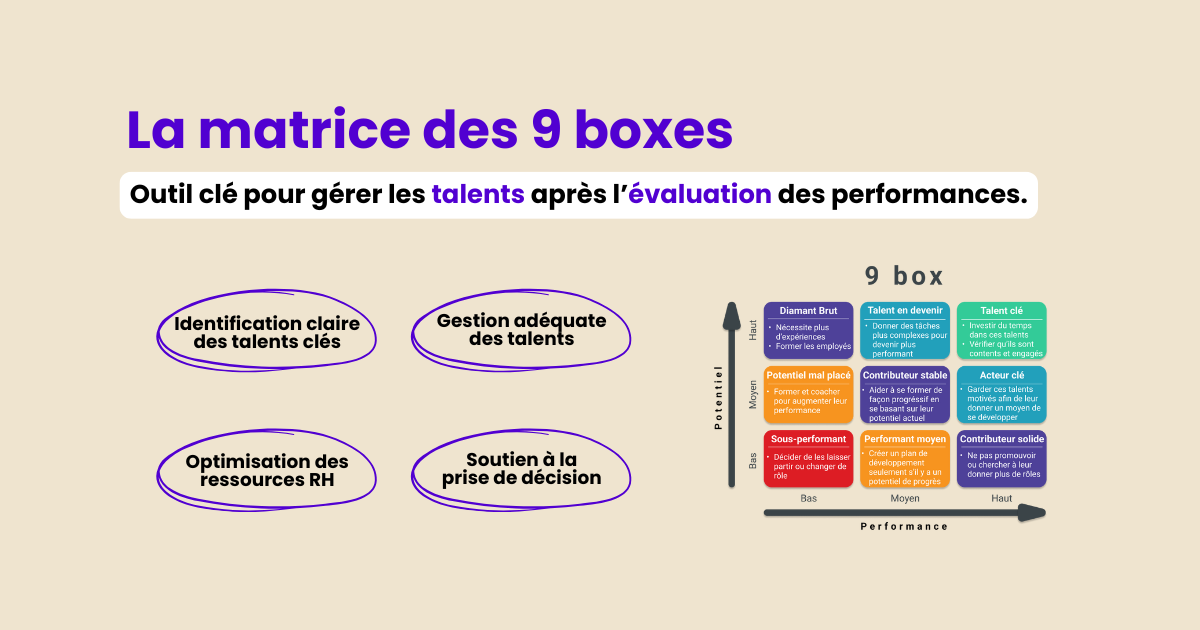
The 9-Box Matrix: A Key Tool for Talent Management Following HR Assessments
The 9-Box Matrix (9-box grid) is much more than just an HR tool: it is a strategic lever for identifying and developing talent within an organization. Used after a performance evaluation, this matrix allows you to cross-reference employees’ performance and potential to better plan their career development within the company.
Although its exact origin is difficult to trace back to a specific individual, it is generally attributed to the talent management approach developed by General Electric (GE) under the leadership of Jack Welch in the 1980s.
Today, this tool has been adopted by many companies and enhanced over the years by contributions from HR specialists and management consulting firms.
Read on to find out how this tool can help you make informed decisions, optimize talent management, and support your HR strategy.
What is the 9-box matrix? What is this 9-cell grid used for?

The 9-box matrix, also known as nine-box grid for performance and potential, is a talent management tool used to evaluate and rank employees based on two main dimensions:
- Performance : This involves assessing the extent to which employees meet or exceed set goals. This dimension is based on quantitative and qualitative data related to past results.
- Potential : This measures an employee’s ability to advance to more complex roles or positions with greater responsibility. This assessment is based on criteria such as learning ability, behavioral skills, and strategic vision.
9-box matrix model
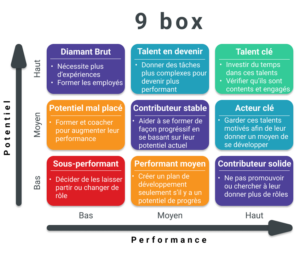
Before exploring the 9-box matrix model, it is important to understand its structure and how it helps organize employees based on their performance and potential. This model is divided into nine boxes (3×3), forming a grid that combines three levels of performance—low, average, or high—with three levels of employee potential—low, average, or high.
Each cell represents a unique combination of these two criteria. This makes it possible to quickly identify high-potential talent, those who need support to advance, and those who can be considered for succession planning or career development. Viewing this matrix enables decision-makers to make more informed strategic decisions regarding talent management.
Here is what a typical 9-cell matrix looks like:
Objectives of the 9-box grid in performance management
The 9-box matrix serves several key purposes in performance management, thereby helping to optimize talent management by enabling a clear and structured evaluation of employees. It not only helps identify high-potential talent but also defines appropriate actions for all employees. Among the main objectives it helps achieve are:
Succession Planning: Identifying Key Talent for Critical Positions
The 9-cell matrix helps identify high-potential employees who could fill key roles within the organization in the future. By cross-referencing performance and potential, it helps identify talent capable of taking on strategic roles—with leadership potential—when critical positions become available. This proactive approach ensures effective succession planning, reducing the risk of talent shortages and ensuring long-term business continuity.
Performance Management: Understanding Strengths and Weaknesses Within the Organization
Thanks to the 9-box matrix, HR managers can gain a comprehensive overview of employee performance across the company. It helps highlight each individual’s strengths and identify areas for development. By clearly understanding where employees stand in terms of performance, the organization can take targeted action to build skills and improve overall results.
Talent Development: Tailoring training plans to identified needs
The 9-box matrix provides valuable insights for tailoring employee development paths. Depending on where employees fall within the matrix, tailored training plans can be implemented to maximize their potential. For example, high-potential talent may benefit from leadership programs, while those with solid performance but room for growth could be offered training to acquire new skills and prepare for higher-level roles.
Strategic Decision-Making: Allocating HR Resources Based on Priorities
One of the key strengths of the 9-cell matrix for management is that it enables leaders to make informed strategic decisions regarding the allocation of human resources. By identifying key talent and organizational needs, it helps prioritize training investments, guide promotions, and determine the steps needed to address skill gaps. In this way, it enables HR efforts to be focused where they will have the greatest impact on the company’s performance and growth.
The advantages of the 9-box grid
The 9-cell matrix offers several advantages that make it a key tool for talent management within the organization. By cross-referencing performance and potential, it helps identify each employee’s strengths and areas for development, thereby facilitating strategic decisions regarding human resources management. Among the advantages of the matrixinclude:
- Makes it easy to identify high-potential and high-performing employees.
- Support for succession planning and preparation for strategic roles.
- Provides a framework for tailoring development plans to employees' specific needs.
- Prioritize investments in training and coaching for high-impact talent.
- Provides a clear and concise overview of the organization’s strengths and weaknesses.
- Decision-making support to guide actions in a strategic and consistent manner.
How can you use the 9-cell matrix in HR management?

The 9-box matrix is best used following a comprehensive performance evaluation, as it provides a clear and strategic overview of each employee’s individual results and potential. By cross-referencing performance and potential criteria, this matrix offers a comprehensive view that enables informed decisions regarding talent management. Here are the key steps for effectively implementing this approach:
1- Once the assessment results have been collected, the data must be consolidated in a suitable HR tool
After collecting the results of performance and potential assessments, it is essential to centralize this data in a suitable HR tool. This centralization allows all relevant information to be gathered in one place, providing a comprehensive overview of employees. This facilitates analysis and decision-making and ensures that HR professionals have quick and accurate access to all the information needed to manage talent strategically.
2- Performance: Analyze employees’ results, skills, and feedback to place them on the “performance” axis
Once the data has been centralized, it is important to analyze employee performance by taking several factors into account: results achieved, skills demonstrated, and feedback received. This step allows us to objectively and comprehensively assess each individual’s performance. It serves as a basis for understanding where each employee stands within the organization and for identifying their strengths and areas for improvement.
3- Potential: Assess their ability to take on more complex roles, taking into account their leadership skills, adaptability, and strategic vision
Potential assessment involves evaluating employees’ ability to take on more complex roles in the future. This includes analyzing their leadership skills, adaptability, and strategic vision. An employee with high potential may be groomed for leadership positions or more strategic roles. This assessment helps identify key talent for future assignments and plan their development accordingly.
4- Cross-reference performance and potential levels to place each employee in one of the 9 categories
Once performance and potential assessments have been completed, these two dimensions should be cross-referenced to place each employee in one of the nine quadrants of the matrix. This cross-referencing provides a visual and structured overview of the talent landscape within the organization, thereby facilitating decision-making regarding the actions to be taken, whether they involve development, reassignment, or promotion.
5. Interpreting the results
Interpreting the results enables informed decisions to be made regarding employee development. “Key talents”—those who combine high performance with high potential—should be provided with advanced development plans, including specialized training, leadership opportunities, and strategic assignments. Conversely, employees identified as struggling require more targeted support, whether in the form of specialized training to improve their skills or assistance with their personal and professional development.
6- Use the matrix to tailor development plans, plan for succession, and address the issues identified
The 9-box matrix becomes a powerful tool for taking action when it comes to tailoring employee development plans. It enables organizations to plan succession for key positions, design customized training pathways, and address identified issues—whether they involve underperforming talent or untapped potential. By aligning development initiatives with organizational priorities, it contributes to more effective and strategic talent management.
Key stakeholders in the development of a 9-box matrix

The Talent Review is a key step in which the 9-box matrix takes shape and becomes a strategic tool for the organization. Several key stakeholders participate in this meeting, including:
- Line managers : They provide the most accurate assessments of their team members’ performance and potential.
- HR : They ensure that evaluation criteria are applied fairly and strategically.
- Management : For key positions, management approves decisions and ensures that the identified talent aligns with the company’s future goals.
This collaboration makes it possible to assess the potential and performance of employees and to identify concrete steps for their development, aligning individual goals with the organization’s strategic needs.
Streamline the process with an HRIS
Talent assessment and the use of the 9-box grid can be greatly simplified with tools such as Talenteo. Thanks to its assessment module, you can centralize, analyze, and effectively act on your assessment results. Plus, it can be synchronized with the training management moduleto ensure optimal planning of your skills development strategy.
Talenteo therefore not only allows you to track performance, but also to manage talent development through concrete and measurable actions.
Why use an HRIS for HR evaluation?
An HRIS (Human Resources Information System) automates many processes essential to performance evaluation and monitoring. Thanks to this automation, companies can avoid common human errors associated with manual data management. Individual performance is tracked continuously and systematically, using tools that centralize evaluations, achieved goals, and feedback. This not only simplifies data management but also improves the accuracy of analyses.
Using an HRIS makes it easier to generate clear and detailed reports on employee performance, enabling HR managers to make informed decisions.
In addition, assessment results can be seamlessly synchronized with talent management programs, enabling the creation of training plans tailored to each employee’s needs. This ensures optimal management of career paths, guaranteeing that every employee receives personalized support to develop their skills and achieve their performance goals.
Conclusion
The 9-box matrix is an indispensable tool for any organization seeking to optimize its talent management following a performance evaluation. It provides a clear and structured view of strengths and areas for improvement within the company, enabling HR teams to align their decisions with strategic objectives. By using it methodically, you will not only be able to identify tomorrow’s leaders and those with development potential, but also propose tailored solutions for employees facing challenges.
When properly integrated into HR processes, this tool becomes a powerful tool for boosting engagement, fostering professional growth, and building a stable and agile organization over the long term.